
I. Product Overview
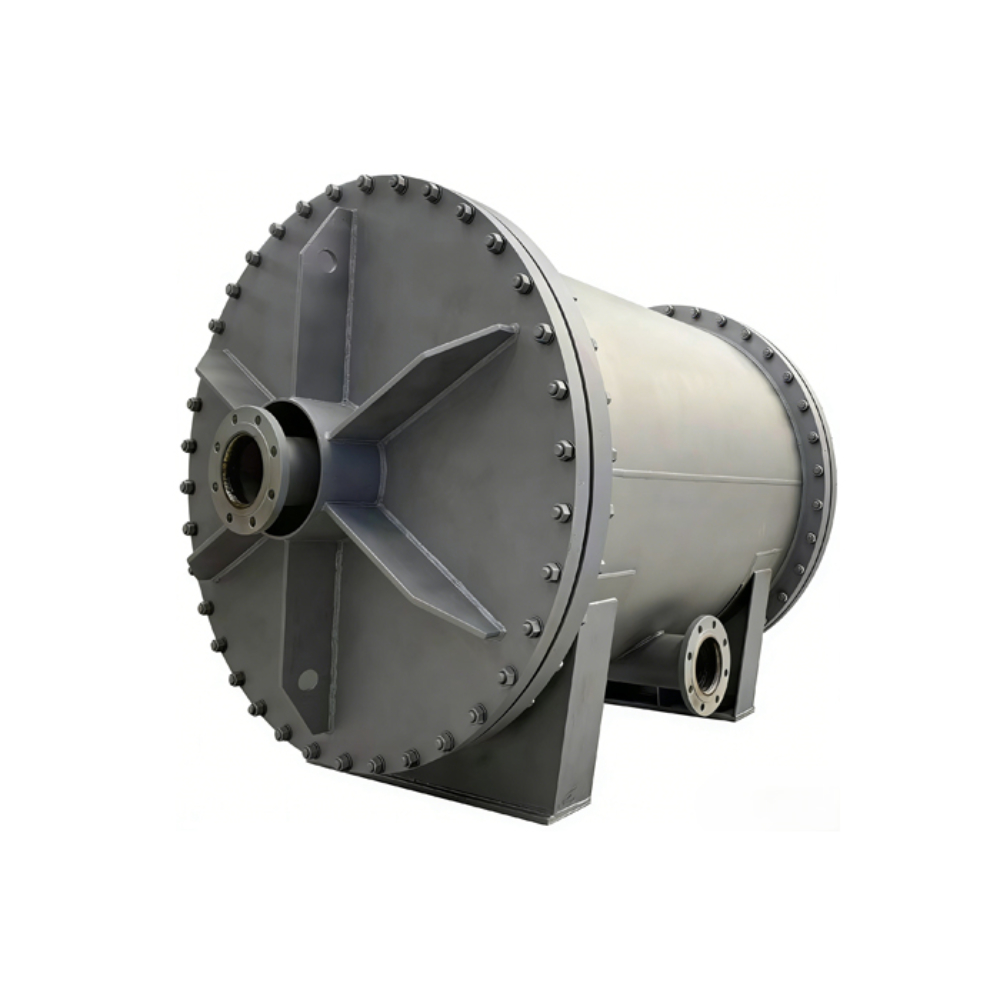
A spiral plate heat exchanger uses two parallel metal plates rolled into spiral channels. Hot and cold media flow countercurrently in two adjacent spiral channels and exchange heat through the plate walls. The channels are kept at a fixed spacing by spacer studs, and the two ends are sealed by welding or detachable seals according to the structural type.
The structural characteristics of this type determine its applicable positioning: relatively wide channels, continuous flow paths, and no stagnant zones, giving it good adaptability to media containing suspended solids, prone to fouling, or with a certain viscosity. In the working condition range where plate heat exchangers are prone to blockage and shell-and-tube heat exchangers have relatively low efficiency, the spiral plate heat exchanger is a feasible choice. It is widely used in chemical, metallurgical, papermaking, pharmaceutical, environmental protection, and sewage-source heat pump fields.
II. Structure and Working Principle
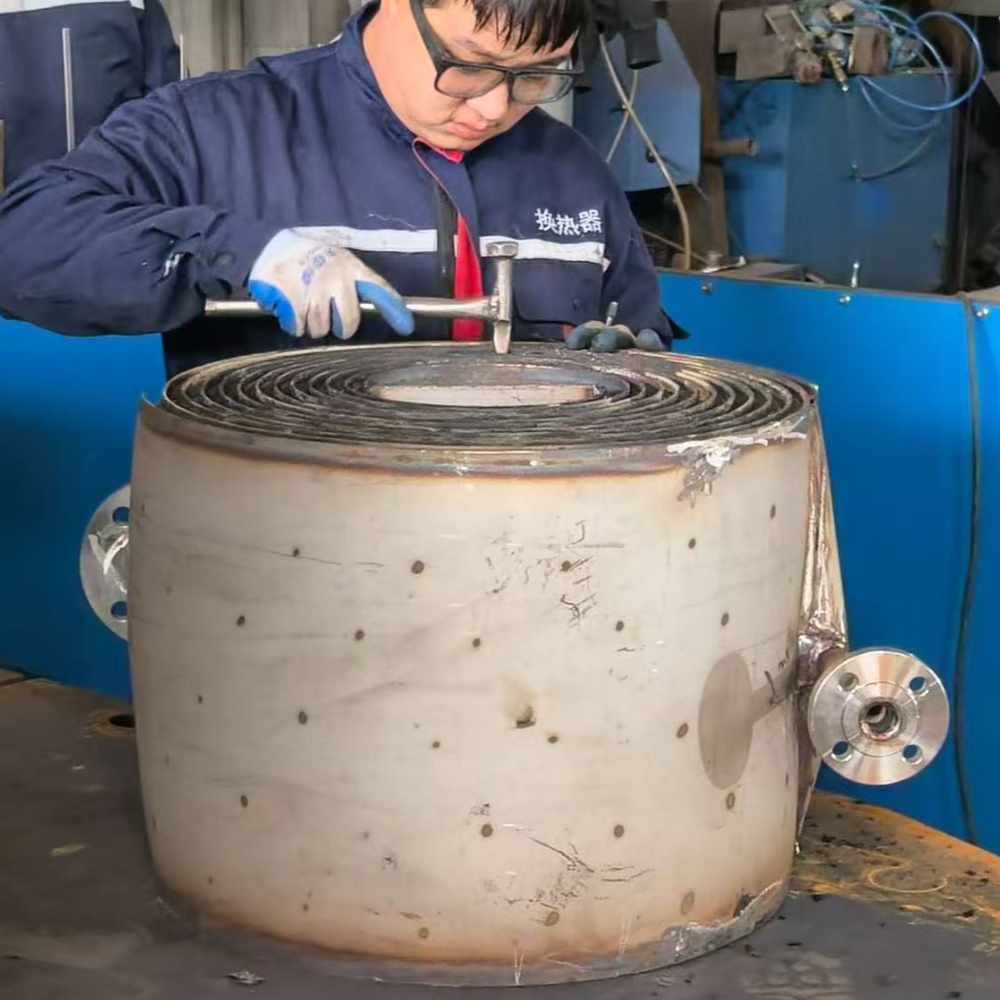
Two metal plates are rolled into a spiral shape on special equipment, forming two mutually non-connected spiral channels. Medium A enters from the center and flows outward along the spiral channel, while Medium B enters from the outer ring and flows inward. The two flow countercurrently throughout the entire path. Spacer studs are welded to the plate surface to maintain the channel width and withstand the pressure difference between the two sides.
Component Function
Spiral plates Main heat transfer body; two plates rolled and formed
Spacer studs Maintain channel width and withstand pressure difference
Center partition plate Separates the starting sections of the two channels
Shell (casing) Encloses the outer channel and connects nozzles
End seal Welded seal or detachable seal; determines whether cleaning by disassembly is possible
Nozzles Medium inlet and outlet; configured according to piping standards
Because the channel is a single-pass continuous structure, the medium maintains a relatively high flow velocity inside the channel, and stagnant zones are not easily formed along the path. This is the reason for its relatively low fouling tendency.
III. Technical Features
Relatively wide channels, good adaptability to solids-containing media
Channel width is usually 5–25 mm, significantly wider than that of plate heat exchangers. Media containing a small amount of suspended solids or fibers are not easily deposited and blocked in the channels.
Single-pass continuous flow path, relatively low fouling tendency
There are no stagnant zones in the channel, and the medium flow velocity is relatively high, providing a certain self-scouring effect and relatively slowing the fouling rate.
Relatively low pressure drop
The single-channel structure has a short flow path. At the same flow rate, the pressure drop is usually lower than that of multi-pass plate structures.
Compact structure
The heat transfer area per unit volume is relatively large, and the footprint and weight are smaller than those of shell-and-tube equipment with the same heat duty.
Asymmetric channels can be designed
When the flow rates on the two sides differ greatly, unequal-width channel design can be adopted to make the flow velocities on both sides close and improve heat transfer matching.
Upper limits exist for area and pressure-bearing capacity
Limited by plate width and rolling length, the heat transfer area per unit usually does not exceed several hundred square meters; pressure-bearing capacity is also lower than that of shell-and-tube heat exchangers. Large-area requirements generally use multiple units in parallel, and high-pressure conditions require evaluation of other types.
IV. Structural Forms
Type End seal Detachable for cleaning Applicable conditions
Non-detachable (fully welded) Welded at both ends No; chemical cleaning only High-temperature, volatile, toxic media with high sealing requirements
Detachable (one side detachable) Gasket seal at one end One side channel can be opened One side prone to fouling and requiring mechanical cleaning
Detachable (both sides detachable) Gasket seal at both ends Both side channels can be cleaned Both sides prone to fouling
Semi-detachable One side welded, one side detachable Partially detachable Balancing sealing and cleaning requirements
During selection, first determine the cleaning requirement, then determine the sealing form. For clean media where chemical cleaning is the main method, choose the welded type; for media with high solids content requiring periodic brushing, choose the detachable type.
V. Technical Parameters (Design Reference Values)
Item Range
Heat transfer area per unit 1–250 m²
Plate width 300–1500 mm
Plate thickness 2–6 mm
Channel width 5–25 mm (asymmetric design possible)
Design pressure 0.6–2.5 MPa (determined by structural form)
Design temperature Welded type up to 400 °C; detachable type limited by sealing material
Heat transfer coefficient Approx. 1000–3000 W/(m²·K) for water-water conditions
Material Carbon steel, 304, 316L, 321, duplex steel, titanium
Applicable standards GB/T 151 Heat Exchangers; export projects can be executed according to agreed standards
The above are conventional ranges. Actual parameters are determined by calculation based on working conditions and are subject to the technical agreement and drawings.
VI. Material Selection
Material Applicable conditions
Carbon steel Water, alkaline solutions, non-corrosive conditions; relatively low investment
304 Neutral media; not suitable for high-chloride conditions
316L General chemical media, weak acids and alkalis; contains molybdenum for pitting resistance
321 High-temperature conditions; intergranular corrosion resistance
Duplex steel 2205 Chloride-containing and sulfur-containing media
Titanium Seawater, chloride solutions, oxidizing media
Plate thickness is greater than that of plate heat exchangers, and the material cost proportion is higher. During selection, excessive material upgrading should be avoided on the premise of meeting corrosion resistance requirements.
VII. Manufacturing and Quality Control
Stage Control points
Plate material Incoming inspection; confirmation of thickness and surface quality
Spacer stud welding Control of weld spot strength and spacing; directly affects channel dimensions and pressure-bearing capacity
Rolling and forming Control of spiral pitch uniformity to ensure consistent channel width on both sides
End seal Weld inspection for welded type; flatness control of sealing surface for detachable type
Pressure test Hydrostatic and air tightness tests separately for channels on both sides
Documentation Material certificates, test records, certificate of conformity, operation manual
Rolling precision is a key process for this type of equipment. Uneven channel width will cause flow velocity deviation on both sides, thereby affecting heat transfer and pressure drop performance.
VIII. Applicable Working Conditions and Industry Applications
Chemical: acid washing liquid cooling, alkaline liquid heat exchange, solids-containing material cooling, reactor jacket circulation
Metallurgy: quenching fluid cooling, heat exchange in pickling processes, emulsion temperature control
Papermaking: black liquor and white water heat exchange and waste heat recovery
Pharmaceutical and food: cooling of particle-containing materials, fermentation liquid temperature control
Environmental protection and municipal: wastewater treatment, sludge heat exchange, sewage-source heat pump systems
HVAC: waste heat recovery, district heating heat exchange stations
Selection criterion: the medium contains suspended solids or fibers, is prone to fouling, has relatively high viscosity, is sensitive to pressure drop, and the required heat transfer area is within several hundred square meters—these working conditions are the main applicable range of the spiral plate heat exchanger. If the medium is clean and high efficiency with small volume is required, plate heat exchangers are more suitable; if the pressure is high and the area is large, shell-and-tube or spiral-wound tube heat exchangers should be evaluated.
IX. Parameters Required for Selection and Service Process
To be provided: names and composition of media on both hot and cold sides, flow rates, inlet and outlet temperatures, operating pressure and design pressure, design temperature, allowable pressure drop, solids content and particle size, fouling tendency, chloride ion concentration and pH, installation space.
Service process: Working condition confirmation → selection calculation → scheme and drawings → technical agreement → manufacturing → factory inspection → delivery and technical support
X. Company Overview
Shanghai Jiangxing Chemical Equipment Co., Ltd., located in Jiading District, Shanghai, focuses on the design and manufacturing of heat exchange equipment. Its products cover two major categories—plate type and tubular type—with ten varieties in total, including fully welded plate, four-side detachable fully welded, detachable plate, and brazed plate heat exchangers, as well as plate-and-shell, shell-and-tube, volumetric, spiral-wound, finned-tube, and spiral plate heat exchangers, and accessories such as plates and rubber gaskets.
The company is equipped with a 10,000-ton hydraulic press and has independent production capacity for plates and pressed parts. It has passed ISO 9001 quality management system certification and obtained CE certification. Its products have been exported to more than 80 countries and regions, with many years of export experience. It currently has more than 390 product specifications and can undertake non-standard customization.
COMPANY PROFILE

Founded in 2010.Shanghai Jiangxing Chemical Equipment Co.,Ltd. is located in——Shanghai,China. We specialized in manufacturing series of plate heat exchangers, fully weldedheat exchangers,heat exchanger units, replacements of plates and gaskets,brazed plate heatexchangers. Our plate heat exchangers are quality reliable and equivalent to the products fromworld well-known manufacturers. We also supply high quality OEM heat exchanger gaskets( EPDM, NBR & VITON ) and heat exchanger plates(Stainless Steel, Titanium, Hastelloy ) forplate heat exchanger ordinary maintenance.
EXHIBITION & CUSTOMER

CERTIFICATES

Why Choose Us

FAQ
1.Can l have your samples?
Yes, we can provide samples for you to check our quality.
2. What is your leading time for the products l need?
enerally 7 working days. lt depends on the quantities you request.
3.Do you have your own factory?
Yes, welcome to visit our factory and check our products.
4. What is the warranty for your products?
We provide one year warranty for all the items we sold.
5.What payment terms do you accept?
Trade Assurance/TT/ Letter of Credit/ Western Union
